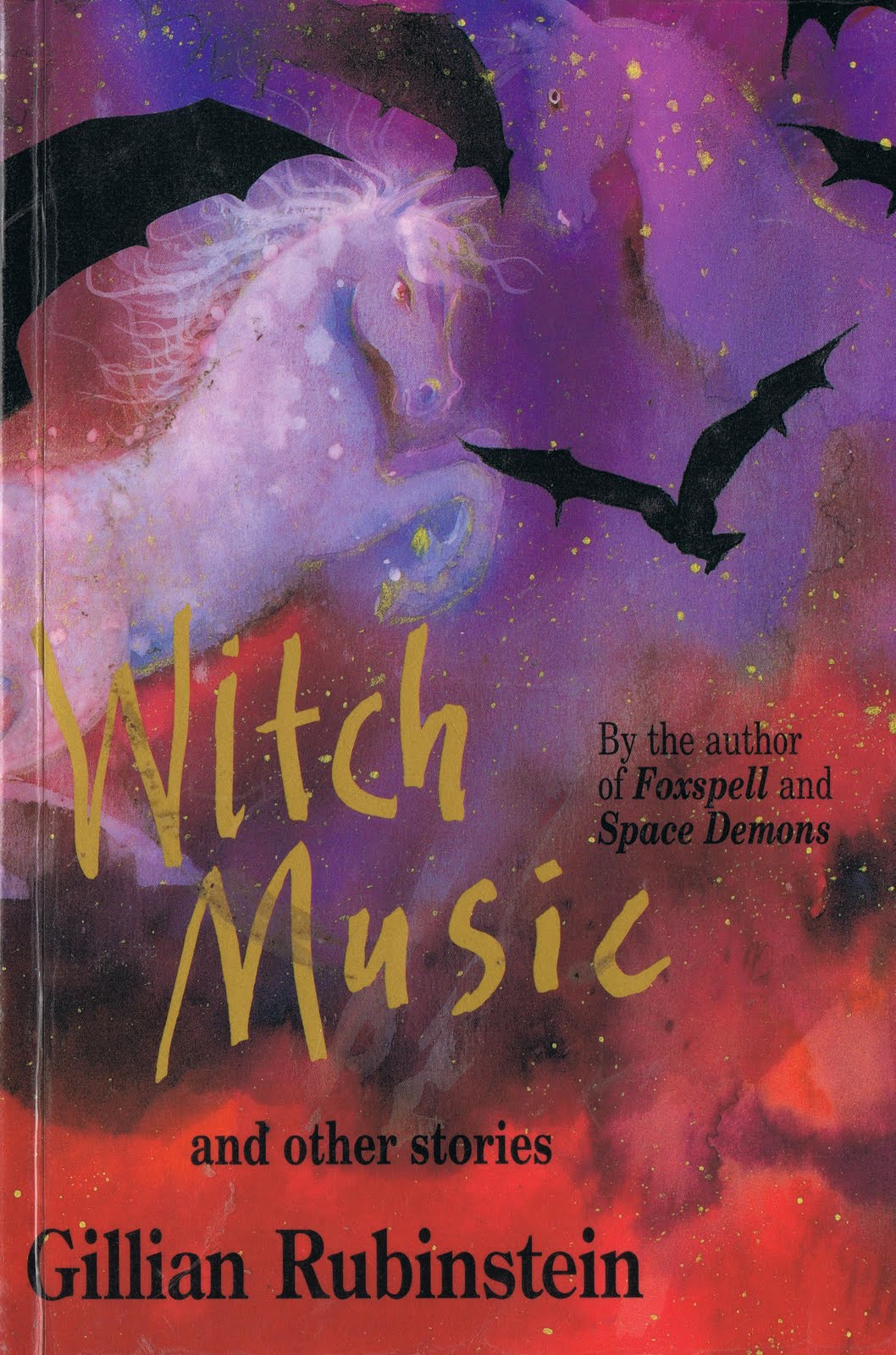
As I was driving the kids to school yesterday, the almost-9-year-old announced that a girl in the book she was reading liked to cut shapes in her hand with a pencil sharpener and drip blood onto her school books.
Inwardly, I was horrified, but outwardly I attempted to stay calm. I didn’t want to raise any flags. So, I asked in my most measured voice what the book was called.
Witch Music.
My daughter has owned Witch Music for more than a year. She has read it many times. She has never previously mentioned it containing descriptions of a young girl self-harming.
The book – by Gillian Rubinstein – looks innocuous enough. The back cover says it contains “ordinary tales of primary school, seaside holidays and homelife … suddenly magically transformed when you see them through Gillian’s eyes.”
Doesn’t exactly scream complex psychological issues explored inside, does it?
Hearing my daughter’s matter-of-fact pronouncement freaked me out, because I’ve been hearing terrible reports about girls at her school self-harming.
It’s not just my daughter’s schoolmates, Australian girls generally are not being particularly kind to themselves when it comes to sharp objects.
In June, The Age newspaper reported: “Hundreds of children aged 10 to 14 are being hospitalized after harming themselves, and the rate has grown by 35 per cent in just under a decade.”
The increase has been so dramatic across the board because of a 50 per cent rise in girls self-harming themselves.
Why? Because they are anxious or depressed. What on earth does a 10-year-old have to be anxious or depressed about?
The expert quoted in the article, child psychiatrist Paul Denborough, suggested “the rise in children self-harming could be due to a combination of greater awareness and greater incidence of mental health issues”.
Oh-kay, my daughter now has a “greater awareness” of self-harm.
So, why the greater incidence of mental health issues?
“Kids are drinking earlier, smoking earlier, self-harming earlier, having sex earlier … the younger you have your adolescence the more stressful it is and the less skills you have in coping with adult situations.”
Sure, that explains the pre-teens. But how about the primary school kids? Why are they doing it?
Dr Stuart Shanker, a Canadian research professor, told Health+Medicine that too much visual stimulation from devices such as television, computers and video games are partly to blame. But parental stress also played a part, from factors such as economic crisis, marital breakdown and urban living. As a result, kids’ ability to “self-regulate” has been compromised.
“Self-regulation is the ability to manage your own energy states, emotions, behaviours and attention, in ways that are socially acceptable and help achieve positive goals, such as maintaining good relationships, learning and maintaining wellbeing,” Dr Shanker says.
I’ve spent the last 24 hours wondering what do I do now?
I don’t know what to say to her.
What do I say to her?
What can I say that will stop her doing something so terrible to herself?
HOW DID PARENTING GET SO COMPLICATED?
 housegoeshome
Just this week my daughter came home and said girls at her primary school (she’s in Year 6) are cutting themselves. On further discussion it sounds like they are “scatching” themselves in view of others, and claiming that they are going to “cut” themselves. My daughter says “they are just trying to get attention”. The Principal spoke to the class yesterday about the issue although my daughter reckons he thought the same as her that they were trying to get attention. Even if that is the case, I’m not sure that’s the best approach to dealing with it. Although, it could well be that more stories in the media (and obviously in children’s books) have increased their awareness and so they aren’t deliberately trying to hurt themselves.
The same day we heard this at the dinner table the Year 9 daughter named off about five girls in her year who she believes are depressed.
It seems so bizarre that children this young are dealing with such pain!
I think it’s true that financial pressures and marital instability have a big impact on young children. I also think schools are a lot more “hothouse” type pressure these days. The kids go from school teachers lecturing them about their behaviour, their homework, their marks to home where parents start on them, and then if you add in extra-curricula activities to the mix that’s more people with the expectations on practising, training, participating. More pressure. I don’t think kids get the “chill out” “alone time” “unsupervised play” that we used to get and if I think about that was my stress release.
In regards to your daughter, don’t panic, she’s not cutting herself. The book just opens up an opportunity to discuss the topic with her. Try to explain how sad it is that someone would feel that bad, and how important it is if you feel sad or worried or upset you must talk to someone, mum, a teacher, dad, even siblings rather than let it build up, and up, and up.
I agree with Shambolic. It’s an opportunity to talk. Tell her that books give us an opportunity to learn about other people and how NOT to do things. And that you or someone she trusts would ALWAYS want to help her if she felt so bad. And you don’t want her to feel alone or without someone to talk to, EVER.
Something along those lines …
However, I don’t take the view that life is more stressful etc. I think we are more open and peoples sense of harm has changed in the last few generations. Kids were always spinning out of control and putting themselves in harms way. Now, I think more people care and monitor how that harm takes place. And all that information is available all the time. It is scary but it gives us an opportunity to create better communication with our kids and possibly their friends, should they choose us to be the person they trust.
Books like this are useful learning tools. As the above comments have said, this is an opportunity for you to talk to her about it openly. That’s much better than her getting her “information” from other kids at school! I agree it’s a shocking thing but it WAS also around in my generation (twenty-odd years ago), and I remember being so scared of so many things. Books always helped me work things out! I’m absolutely dreading having to deal with this stuff with Tiger, though, and I really feel for you!
Thanks for all the advice, fellow mums. I opened up the dialogue last night.
Just use it as a “teaching moment”, ie, read the book yourself perhaps and then discuss. Gillian Rubinstein is great! Her older kids books do touch on tricky subjects though, ie, similar to my favourite NZ children’s author, Margaret Mahy or UK author, Jacqueline Wilson. My kids were not very advanced independent readers so I used to read aloud to them a lot even when older. This was good in that it provided an opportunity to discuss some of the content.